
xCoin · XID · mainnet live since September 26, 2026, 00:00 UTC · money rules frozen at genesis
Post-quantum money. Mined by anyone.
Every spend is signed with post-quantum keys only, ML-DSA-65 or SLH-DSA, the NIST standards, since genesis; there is no classical key to migrate away from. The mining puzzle is built for the Mac you already own, so the coins go to people, not warehouses. 100 million, no premine, 50 XID per block after a seven-month warm-up, then 10% less every 110,000 blocks, never below 1.5 XID until 2325, no token sale.
After 2325 the reward tapers from 1.5 to 0.1 XID; the last coin is mined around 2363, inside the 100,000,000 cap.
Network status
mainnet · reading superknet.com
Live from the explorer at superknet.com. Mainnet has been live since genesis, September 26, 2026, 00:00 UTC; these are live mainnet figures. Nothing here is simulated.
Four things that are true today
not a roadmapNothing to migrate, ever
Other chains plan to switch signatures later and hope every holder moves every coin in time. Lost keys never move. xCoin never issued a classical key. A classical signature is not weak here, it is invalid.
The warehouse gets no shortcut
MetalDAG makes every guess read 64 random pieces of a 4 GiB dataset. The dataset grows 128 MiB every 14-day epoch. The bottleneck is memory bandwidth, which is what Apple Silicon’s unified memory does best.
Four lines, never change
100,000,000 XID, 8 decimals. 50 a block after a seven-month warm-up, 10% less every 110,000 blocks, never below 1.5 until 2325, then a taper to the last coin in 2363. No premine, no founder allocation, no sale, no venture round. Every coin is mined, none are granted. The schedule.
No passwords anywhere
The forum account is your mining address, proven by signing a challenge. Your reputation is your mining record, read from the chain. Bots would have to mine to spam.
Emission: the Annual Tenth
XID · 8 decimals · mainnet live since September 26, 2026Fifty a block, ten percent less each year, never below one and a half.
Every XID is mined; none are granted. There is no premine and no founder allocation. The cap is exactly 100,000,000 XID, to the sat. This is the mainnet schedule, live since genesis on September 26, 2026, 00:00 UTC; explorer at superknet.com.
Mining calculator
What would your rig earn?
Averages, not a promise: mining is a lottery, and these are expected values at today's network, read live from the explorer. No dollar figure, because no market exists yet.
Warm-up
6.25, then 12.5, then 25 XID per block, for 20,000 blocks each. The first weeks do not concentrate coins before more miners arrive.
Fifty, flat
50 XID per block from block 60,001 to block 220,000.
The tenth
Then 10% less every 110,000 blocks, about 382 days at five-minute blocks. The reward halves about every seven years, with no overnight cliff.
Floor, then fade
Never below 1.5 XID per block, from about 2063 to about 2325, paid inside the cap. Then a short fade; the last coin is mined around 2363.
Pay never halves overnight
Bitcoin cuts miner pay in half overnight every four years. XID never cuts more than 10%, and only once about a year. Miners can plan.
Done properly
No premine, no founder allocation. The warm-up (6.25, 12.5, 25, then 50) keeps the first weeks from concentrating coins.
Miners stay paid
A 1.5 XID floor, paid inside the 100,000,000 cap, keeps miners paid from about 2063 to 2325. Fees are not asked to carry the chain alone.
A table, not a promise
65 rows of whole-number rules, and a SHA-256 of the table written into the charter that sits in the genesis block. Anyone can add it up to 100,000,000 XID.
Slow after year 20
New supply falls to about 1.5% a year by year 20, and about 0.2% a year after that.
Signatures and links
Every coin is secured by NIST ML-DSA and SLH-DSA signatures; connections between nodes use hybrid ML-KEM-768 encryption (XIP-4) from block 0.
Mining, in three steps
under five minutesGet an address
The wallet command line makes one; the xPay app is a demo of the same wallet. It starts with xpa1r. That prefix means post-quantum. There is no other kind.
Mine with MMM
MMM, the Mac Metal Miner, is the recommended miner: in Setup pick Mainnet, explorer https://superknet.com, pool pool.xcoinminer.com port 3335, your xpa1r address. No Mac? Try it in your browser at xcoinminer.com.
Watch it land
A coinbase reward matures after 1,000 blocks, about 3.5 days. The explorer at superknet.com shows every mainnet block and worker, live since genesis on September 26, 2026, 00:00 UTC.
Mine with MMM on your Mac
the recommended miner · open source · Apple SiliconMac Metal Miner
MMM runs MetalDAG natively on the Mac’s GPU with the full 4 GiB dataset in unified memory: live hashrate, shares, blocks, a menu-bar pickaxe and a wallet tab. It checks the mainnet genesis against the explorer before it starts, and it never asks for a seed phrase or a private key.
Setup values for mainnet:
Network   Mainnet
Explorer  https://superknet.com
Pool      pool.xcoinminer.com  (172.96.186.49)
Port      3335
Worker    any name
Password  leave blank
Payout    your xpa1r… address
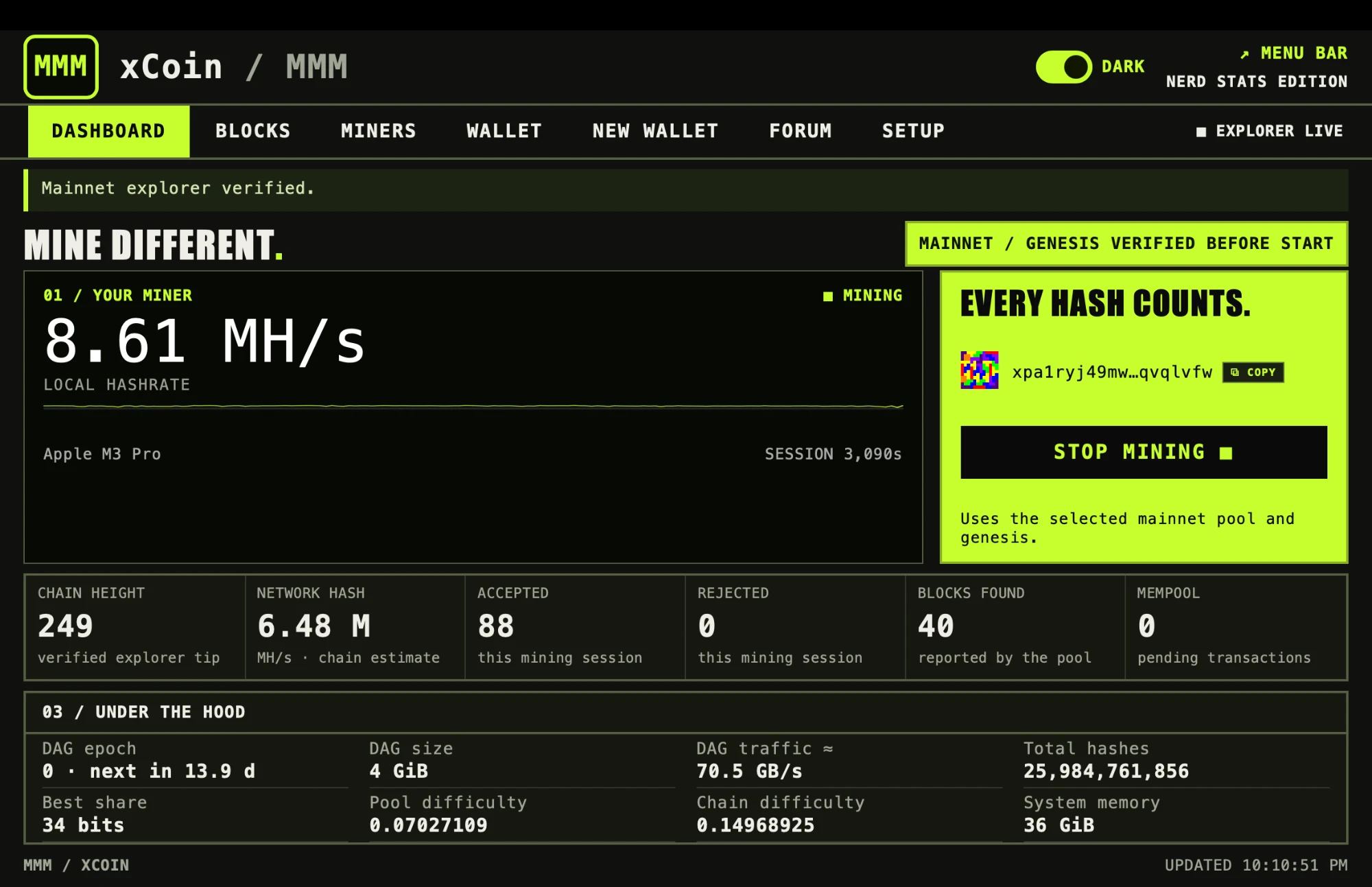
MMM on mainnet: a real session on an Apple M3 Pro, 8.61 MH/s.
What DLT cannot do
Distributed Ledger Technologies builds and runs the reference software and the public infrastructure. It does not sell coins, does not list XID on any exchange, and makes no claim about its value.
Consensus has no admin keys. DLT cannot freeze, seize, or reassign a coin, cannot print past the cap, and cannot change a rule without a protocol upgrade every node operator chooses to run. The charter, committed in the genesis coinbase, forbids an administrative key at this layer.
What genesis carries
Block 0 mints nothing. Its coinbase carries the charter’s commitment, the SHA-256 of the charter text, as its only output, so the money rules and the chain begin in the same block. Supply starts at zero and every coin after it is mined, none are granted.
Mined September 26, 2026, 00:00:00 UTC. Genesis hash 3bc1a36df7d786a5c4584e21d248e0a3785a96aaa60a5b3959dfad50283379f2; charter hash fd9b475afdbe178864f32802726cc60c27290c09efd472d0934b1c733d3b9340.
The charter itself, all nine sections, is on this site. Read the charter.
One ecosystem
built and run in-house · ships code, not promises Xalonopen an account for your Ӿ XID · sign in with Google, unlock with Face ID or a security key · create or import a wallet · self-custody, your keys stay on your deviceOPEN AN ACCOUNT →
AYEDEXAdaptive Yield Equilibrium Digital Exchange · buy Ӿ XID without mining, or sell it · one market: XID / USDC on Stellar · deposits and withdrawals on chain
OPEN AYEDEX →
Xalonopen an account for your Ӿ XID · sign in with Google, unlock with Face ID or a security key · create or import a wallet · self-custody, your keys stay on your deviceOPEN AN ACCOUNT →
AYEDEXAdaptive Yield Equilibrium Digital Exchange · buy Ӿ XID without mining, or sell it · one market: XID / USDC on Stellar · deposits and withdrawals on chain
OPEN AYEDEX →